
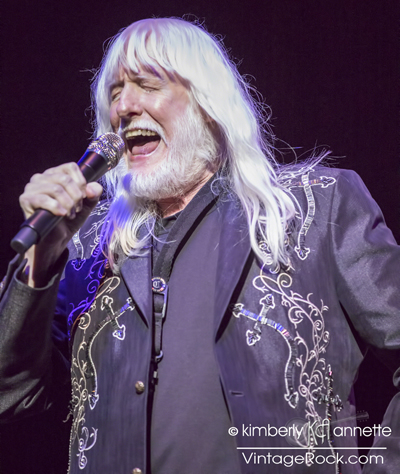
You know him as the man who built “Frankenstein” and took us on a “Free Ride,” but Edgar Winter is a multi-instrumentalist and composer of the highest caliber. Brother to blues guitarist great Johnny, the man as equally comfortable playing synth, alto sax or drums.
The 66-year-old musician has had mega hits and toured the world with some of the best bands ever (including the latest installment of Ringo & the All-Starrs). And, once again, he’s on the bill for this summer’s Rock ‘n Blues Fest with Rick Derringer, Pat Travers, Canned Heat and Ten Years After.
~
Let’s talk about you playing the Rock ‘n Blues Fest.
Well, we did it last year for the first time and it was great. It was such an enjoyable hang. We’re gonna be more focused on the blues aspect on this particular show and we have Ten Years After, Canned Heat, our longtime friends Rick Derringer and Pat Travers. It’s a show reminiscent of those old festivals. I mean, I played Woodstock with my brother Johnny and I loved the variety of the acts there and on all those shows and festivals back in the day, so we like how that spirit is reflected in The Rock n’ Blues Fest.
And Johnny and you are playing some of these shows together, which has got to be something in and of itself.
Yes, my brother Johnny was on the last one, as he is again and that’s always an emotional experience for me. We grew up playing together, playing ukuleles, singing Everly Brothers songs, and although our styles are very different — Johnny really loves the primitive country style blues, people like Muddy Waters and Lightning Hopkins and I gravitate more towards the urban style blues people like Ray Charles, B.B. King — but if there is any common thread that runs through my music it is the blues. I think I’m primarily thought of as a rocker because of songs like “Frankenstein” but I like to play all kinds of music. I never understood why people who like classical can’t like rock or if you’re into jazz you can’t be into country. I love it all. I certainly love the blues.
And blues players can take to the stage pretty much forever.
Right, I’m from that old blues tradition, when I’m 80-, 90-years-old, as long as I can still hobble out there, I’ll be playing. You won’t ever hear about an Edgar Winter retirement tour.
I do wonder, seeing how you have been doing this a while, how do you view the business now?
I never thought of it as a business. I had no intention or desire to become famous. My brother was very ambitious. He had that dream at an early age, he watched Bandstand and read the magazines; he was Johnny Cool Daddy Winter. I was the weird kid who played all the instruments so when Johnny graduated to guitar I figured I’ll just play everything else. Current trends never meant anything to me; I always loved music in and of itself, just the beauty of harmony and rhythm. I’m there to play whether it’s on a small stage or at the Madison Square Garden.
Can we expect any new music?
I have a home digital studio and I’m constantly writing. But I am working on a book of poetry called “Songs That Never Were,” a compilation that started out as a book of song lyrics that I never incorporated into songs. As I continued to write them over the years and grew more spiritual, I found I’m writing a lot to my wife Monique, who I’ve been married to for 35 years…not bad for rock and roll (growls).
I’d say!
So, I think this book of poetry probably accurately represents who I am and what I am about currently more so than the music. I also have a series of short stories that are science fiction fantasies based in a mythical realm called, they are called “Stories From The Shadowlands” and I have songs for a soundtrack that goes with that. Then I am also working on a Broadway style musical comedy about Frankenstein.
That’s a whole bunch of irons in the fire, huh?
Yes, but I think the poetry book will see the light of day first. But back to your original question I’ll always release an album every four to five years because I enjoy doing them, it’s something I can do around the house for fun just to let people know I’m still around. I don’t expect them to make money, that’s never been my primary interest in the first place. The joy of playing — that’s why I’m out on the road and hope to be out there for many more years.
All these years playing, has your style or approach to playing changed in regard to keyboards or any of those many other instruments you play?
I happen to be thought of as keyboardist I know and a rocker because of “Frankenstein.” When it first came on the scene, the synthesizer was a very controversial instrument. I have been both accused of and acclaimed for ushering in the era of the synth. People saw it as putting musicians out of work, for dehumanizing music, etc. But I always was interested in seeing what the instrument could do. There were people using the synth to simulate the sounds of already existing instruments, others were more like programmers then musicians, creating loops. But I looked at it from the view point that I always liked science fiction, soundtracks like the sounds of the Theremin in “Forbidden Planet” and things like that so I wanted to see if I could create some never before heard sounds , so that was and remains my approach. Using the infinite flexibility of a synthesizer — modulating, vibrato and pitch bend — I think that all makes it the most human of instruments really. Having said that, I don’t consider myself primarily a keyboard player. I am an alto sax player. It’s such an organic instrument, fueled by your life’s breaths. It becomes an extension of yourself. The alto sax is what I feel closest to.
I so want to ask about “Frankenstein,” but I know you have been answering questions about it for years now.
Oh, I love that song! I know lots of classic rock guys that say they get tired of those old hits they had but I have never gotten tired of that song or “Free Ride” for that matter. Absolutely, ask anything you like about “Frankenstein.”
It’s just that the riff is so distinctive and I know you’ve told the story before, but run through the history of Frankenstein’s creation. Hearing it from you and not reading it off of some assumptions and half- truths off of Wikipedia is what our readers and I would find so special.
Actually I wrote the basic riff years before the song was released. I wrote it in ‘68 something like that when I was still playing with my brother Johnny. Nobody even knew he had a brother. Johnny would do the first half of the set with his blues trio a then say, “Ok, now I’m gonna bring on my little brother Edgar,” and I step out and the crowd goes, “There’s two of them?” So that riff I developed to feature my instrumental abilities. I played Hammond B3 and alto sax and there were two sets of drums on stage. I did a duel drum solo with Red Turner, Johnny’s drummer, that we used to call “Double Drum Song.” We even played a version of that at Woodstock. So it was that riff I wrote on the Hammond(sings), “Dada dada da da da da.” We used it for years to walk on to, jam to, etc.
With the advent of the synthesizer, I was looking for a vehicle to feature the synth and I thought that old double drum song riff would be killer with that subsonic reinforced synth bottom. So we worked it up as a live song and it was just incredible. I had just come up with the idea of putting the strap on the keyboards, I’ll never forget that first night I walked out, the crowd went crazy, nobody had ever done it before and its was such obvious simple idea you just think someone have to have thought of it before, but I really just happened to be the first person to do it. I remember playing a show with Billy Preston, and then two weeks later I saw Billy and saw him to it!
The sincerest form of flattery.
Right, Definitely! So when I got the synth I was trying to push the envelope anyway I could, come up interesting sounds you have never heard before, get out from behind that big bank of keys, whatever. Every time I’d come up with a song design I liked it would spark my imagination and I’d write a new section to accommodate that particular sound. When I came up with the bubbling (blurps), I wrote that 6/8 section and that descending part, all of those things. It was definitely a song that took several months of evolution.
When I formed the Edgar Winter Group, I thought the strength in that group lay in the co-writing with Dan Hartman and we thought “Free Ride” was going to be the hit, never intending for what we called at that time, “The Instrumental,” to even be recorded. By that point, it had changed where I was playing timbales on stage with the drummer during it as setting up a second set of drums was getting difficult. So at the end of the project, near the completion of what would be They Only Come Out At Night, we had some version of that instrumental because it was fun to play and those days in the studio you always kept the tape running so we had recorded a few jams of it. So at the end Rick Derringer said: “Maybe we could mix that instrumental into something.” It was a crazy idea, but I love crazy ideas. It had nothing really to do with the rest of the record, but it was excuse to get even more blasted during the end editing session and back then, the way you edited was with razor blades and editing tape, actually cutting and splicing the tape.
I can’t even imagine how nerve-wracking that had to be.
Yes, for sure. I mean if you made a mistake it was all over. So the version we had was like 15, 20 minutes long, There were so many sections because every time a new sound would come to me we’d create a new section. So we have tape lying all over the control room, across the mixing board, across the couch, over the backs of chairs and as we are trying to get it together into a cohesive whole, our drummer mumbles the immortal line: “Wow man, it’s like Frankenstein, taking an arm from there and a leg from there.”
Amazing!
It was synchronicity, serendipity, the very fortunate combination of circumstances slipping into place. Then as a result we came up with the title They Only Come Out At Night and it all came out together. We thought “Free Ride” sounded like the radio hit but when we released it, it went nowhere. We released a few more singles but then when we released “Frankenstein” as a B side to “Hanging Around,” maybe it was, it started to get underground FM air play, then AM picked it up and there were editing it, it just exploded, and it made it to Number One, which was unheard of for an instrumental really. Then “Free Ride” hit as well.
And here you are still doing this so many years later, doing the Rock ‘n Blues Fest.
Yes. And I want to just say to all the fans that we could never do this without them. Their support has meant the world to us over the years and we love you all.