
Review by Shawn Perry
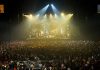
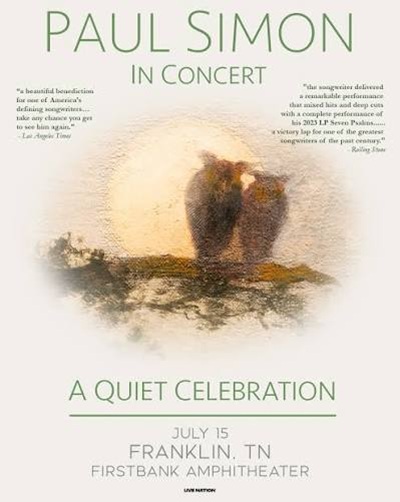
You couldn’t have picked a better night for an outdoor concert with Paul Simon. After numerous bursts of rainfall, the clouds had finally cleared enough across middle Tennessee for a warm and dry evening. It was the first thing Simon acknowledged shortly after he walked up on stage at around 8:15.
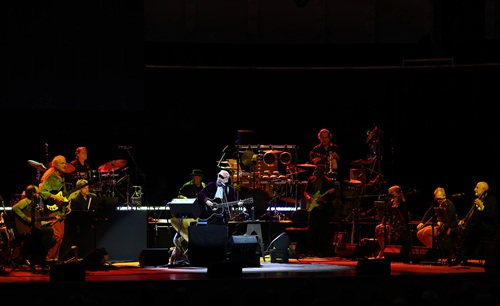
Winding down his North American ‘A Quite Celebration’ summer tour, the singer-songwriter, resplendent in a blue blazer and matching slacks, cut a dashing figure in an area comprising 12 musicians and their arsenal. A reason for the formality is that the night began with Seven Psalms, a 33-minute opus on Simon’s most recent album of the same name, released in 2023.
Based on the singer’s own personal spiritual awakening, the piece is broken down into seven suites, each an inquisition around the quest for purpose, resounded by faith placed in a higher power. Simon softly delivered the solemn lines: “The Lord is the face in the atmosphere…The path I slip and I slide on…” as he was shrouded by flutters of vibes and ambient instrumentation, most noticeably from longtime keyboardist and percussionist Mick Rossi. You could spend the night marveling at Rossi switching from ominous bells and chimes to a smooth electric piano in the span of a verse.
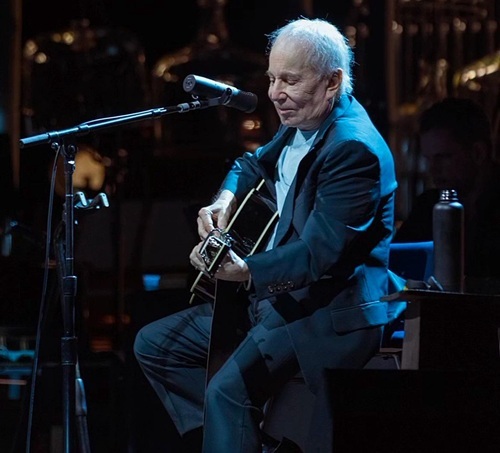
Unlike so many of his contemporaries, Paul Simon refuses to drown in the nostalgia of his work; instead, indulging the audience (and himself) with his latest record. Acoustic guitars to one side and a string section on the other, he swiftly navigated the tight arrangements while encouraging each and every musician to step out of the shadows for a stanza or two of embellishment. Singer Edie Brickell, a frequent collaborator and Simon’s wife, came out to sing with her husband on the final “The Sacred Harp” and “Wait” sections.
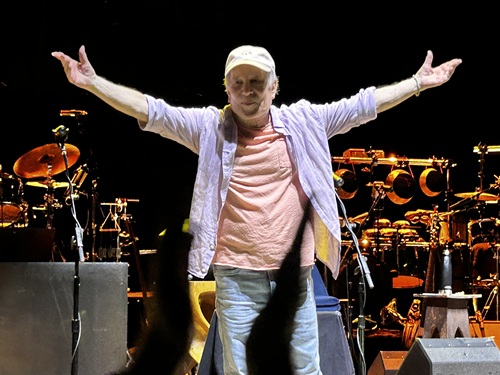
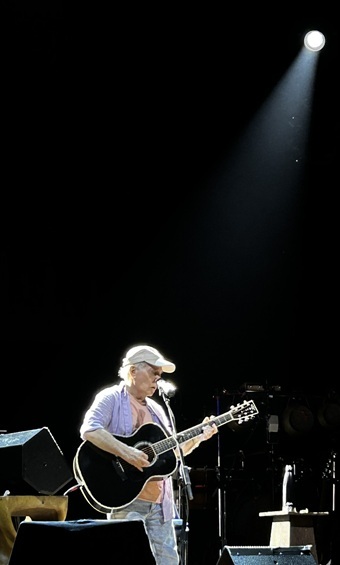
After a brief intermission, Simon in a ball cap, jeans and T-shirt, regrouped with the ensemble for the “hits” portion of the show. With such a vast catalog, from Simon and Garfunkel to his own, there was little time to play everyone’s favorite. And then you have to consider the wellspring of deeper cuts from which the singer can choose. The object is to keep a steady flow of staples tossed in with whatever suits the musician’s mindset. That being said, there was really no better song the second set could have lifted off from than “Graceland,” the title track from the singer’s most successful album.
At 84, there’s limits to what Simon could do vocally. Never a screamer, he pretty much stayed within the constraints of every song he sang. Clearly, the butter-like quality of his younger voice isn’t as resounding as it once was. That’s what growing older does. We can all agree that due to the “quietness” of most of his music, Paul Simon doesn’t need to make any apologies for his vocals.
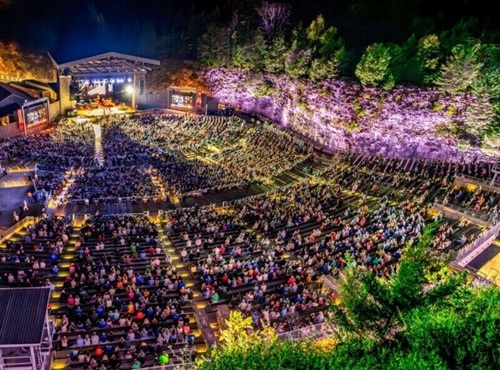
Even so, the unplayed “Kodachrome” might have been a better selection over “Slip Slidin’ Away.” The string players — Nancy Stagnitta on Flute, Caleb Burhans on viola), and Eugene Friesen on cello — carried the added responsibility of background vocals on “Train In The Distance,” a song about Simon’s first marriage, before Andy Snitzer popped up from behind a keyboard to blast a soulful soprano saxophone solo. Of course, you can’t dismiss the heart behind “Homeward Bound.” Once the other players joined in, it was as if goosebumps sweltered in the glow of the amphitheater’s granite walls.
Simon prefaced “The Late And Great Johnny Ace,” the second of three songs played from 1983’s Hearts And Bones, with a few words about the real Johnny Ace and his tragic suicide. Rossi’s take on the keys provided a much-needed edge. “Father and Daughter,” which summoned a photo of Simon with his daughter Lulu at its conclusion, featured a simple round of acoustic riffing between Mark Stewart and Gyan Riley. “Under African Skies,” another one from Graceland, put the spotlight on bassist Bakithi Kumalo, who played on the album and was part of the original touring band.
Simon may be the main attraction, but each musician caught a little sunlight. To achieve the pure musicality that enraptured the audience for over two hours, Simon instinctively knows how to tap into each musician’s strength while maintaining the essence of the song. “Rewrite” allowed Riley to lay down a suave and delicate acoustic solo, while “Spirit Voices” provided an opening for Stewart, who doubles as music director, to slip in a horn solo. Drummer Matt Chamberlin and Jamey Haddad were the main culprits in the all-hands-on-deck drive of “Diamonds On The Soles of Her Shoes” to conclude the main set.
If you’re Paul Simon, what do you do for an encore? You have the pick of the litter, but “50 Ways To Leave Your Lover” was just the right number to get the crowd on their feet, where they stayed for the remainder of the night. In those last moments, the singer shared three of his most poignant songs. “The Boxer” had the band, offering up various melodious accents, and the audience in total sync on the “lie-la-lie” chorus.
Alone, without accompaniment, Simon stepped up to sing the beatific anthem “America.” Here in the heartland, during the month of the country’s 250th birthday, it swayed with particular significance. Finishing off with “The Sound Of Silence,” a collective feeling of comfort and satisfaction swept across the FirstBank crowd. Maybe someone’s heartache felt relief. To experience what a musical treasure Paul Simon was indeed an honor and privilege this reviewer won’t soon forget.