

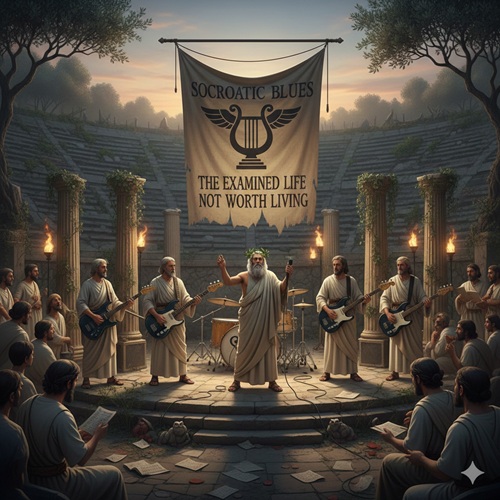
Rock & Roll has always been more than loud guitars and long solos; it’s a soundtrack for examining life itself. When Socrates said, “The unexamined life is not worth living,” he might as well have been talking about the spirit behind albums that asked listeners to think, question, and feel deeply. From the reflective roads of The Eagles’ Hotel California to the searching defiance of Bruce Springsteen’s Born To Run, we are taught that life should be explored, not merely endured.
So many rock songs are built around self-examination. Pink Floyd’s “Time” from The Dark Side of The Moon confronts the quiet tragedy of realizing life has slipped by unnoticed. The Rolling Stones wrestle with desire, dissatisfaction, and identity, while Bob Dylan’s lyrics repeatedly ask who we are and what we stand for. These artists don’t just entertain; they provoke. Their music is a mirror, forcing listeners to confront their choices, values, and contradictions. To engage is to participate in that examination, to ask the uncomfortable questions that make life meaningful.
Jonathan Swift wrote: “Every man desires to live long, but no man wishes to be old.” Rock music has long celebrated youth, freedom, and rebellion. Songs pulse with urgency, as if time itself were an opponent to be outrun. Yet, decades later, these same songs are often played by artists and fans who have grown older together. The meaning shifts. What once sounded like defiance becomes reflection. Aging is no longer the enemy; stagnation is. Rock teaches that growing older does not require growing dull, and that curiosity and passion — not youth — are what truly keep a person alive.
Education, both formal and informal, sits at the heart of this idea. Speaking to the liberating power of learning, Victor Hugo remarked: “He who opens a school door, closes a prison.” Rock frequently acts as an alternative classroom, especially for generations questioning war, inequality, and authority. Albums are textbooks, concerts are lectures, and the lessons stick because they are wrapped in melody and emotion. Lyrics introduce listeners to new perspectives, historical realities, and moral debates. In doing so, the music opens mental doors. It encourages critical thinking, empathy, and awareness — qualities that prevent minds from becoming imprisoned by ignorance or fear.
Ultimately, Vintage Rock endures because it refuses to let life go unexamined. It reminds us that longevity without purpose is empty, that aging without learning is a kind of confinement, and that education — whether found in books, classrooms, or songs — is a force for freedom. Like a great guitar solo, a meaningful life requires attention, courage, and the willingness to explore beyond the familiar. Rock & Roll doesn’t just ask us to listen; it asks us to think, grow, and truly live.