
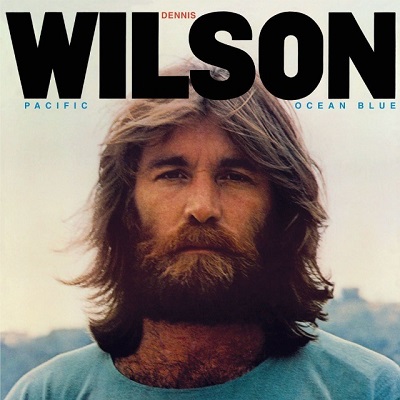
Brian Wilson typically gets credit for the success of The Beach Boys, but it was younger brother Dennis who embodied the look and feel of the surfside singers. The story goes that Dennis came home after a day of negotiating waves and asked Brian to write a song about surfing. And the rest, as they say, is history. Dennis took a backseat on the drum stool to his brother’s mastery of songwriting and studio production during the early and mid 60s, but he eventually developed as a songwriter and singer with a style all his own. His vocal on the 1965 hit single, “Do You Wanna Dance?” boasted his confidence behind the microphone; his compositions, “Little Bird,” “Be Still” and especially “Forever,” proved he could write competent, earthy tunes that helped round out the uneven edges of The Beach Boys’ latter day albums. However, it wasn’t until Pacific Ocean Blue, the very first solo album by any Beach Boy, that Dennis Wilson could be called a true artist of intense emotion and range.
After being out of print for years, Pacific Ocean Blue got the royal roll-out from Legacy as an expanded two-disc set in 2008. In addition to the album’s original 12 tracks, the first disc includes four previously unreleased songs — “Tug Of Love,” “Only With You” (there’s a version of this Mike Love/Dennis Wilson tune on The Beach Boys’ album Holland), “Holy Man” and “Mexico.” The second disc contains the never-released second Dennis Wilson solo album, Bambu. Despite the fact that it never saw the light of day, Wilson reportedly felt Bambu was better than Pacific Ocean Blue. Bundled together in one spectacular package with a snazzy colored booklet adorned with photos and liner notes, the Legacy Edition of Pacific Ocean Blue is something Dennis Wilson and Beach Boys happily added to their collections.
Over seven years in the making, Pacific Ocean Blue was the culmination of a long and hard struggle for respect for the middle Wilson brother. The one-time poster Beach Boy lived life fast and wild — hardening his looks, impeding his abilities as a drummer, and turning his voice into a smoky wisp in the process. But, as Daryl Dragon (aka the Captain who worked on the album) vividly recalls in the reissue’s liner notes, “The richness and instinctive innovation of his (Wilson’s) chords reminded me of the composer Richard Wagner, whom Dennis had never heard of…” And so it begins with the gospel-flavored “River Song,” co-written with brother Carl and sounding distinctively unlike your typical Beach Boys song. “What’s Wrong,” “Moonshine,” “Friday Night,” “Dreamer” and “End Of The Show” were co-written with Gregg Jakobson, who also co-produced and sang background vocals on the album. Jakobson, who contributed heavily to Bambu, is noted for his work in the studio with another well-known figure, mass murderer Charles Manson.
Introspective and downright haunting at times — one listen to “Thoughts Of You” and you’ll understand — if Pacific Ocean Blue encapsulates the moods and meanderings of Dennis Wilson, then Bambu lifts the veil and lightens the load with a rockier edge and a slight Latin influence courtesy of Carli Muñoz, a jazz pianist born and raised in Puerto Rico. “Under The Moonlight” and “Constant Companion” arguably have more commercial appeal than just about anything on Pacific Ocean Blue, while “School Girl” and “Wild Situation” would have felt at home on any Beach Boys record from the 70s. What much of the record basically comes down to is Wilson and the guiding light of the piano — be it the flagrant bounce on “Common,” the stabbing cadences on “I Love You,” or the lucid, transcendent notes on “Piano Variations On Thoughts Of You.” For whatever reason, the lone bonus track, “Holy Man,” features a new vocal by Foo Fighters drummer Taylor Hawkins, sounding eerily like Wilson. Maybe it’s a marketing ploy to reel in the youngsters.
In the end, Pacific Ocean Blue is a classic album that still resonates with power and vitality. Included in Robert Dimery’s book, 1001 Albums You Must Hear Before You Die, Mojo’s “Lost Albums You Must Own” and GQ’s 2005 list, “The 100 Coolest Albums in the World Right Now!,” it’s greatest claim to fame is that it unleashed the hidden genius and creativity burning inside of Dennis Wilson. What a shame the Beach Boy drummer, who drowned in 1983, didn’t live to see it bloom in all its glory and magnificence decades after its release.
~ Shawn Perry